
KHARTOUM, Sudan — An African Union Peace and Security Council delegation held talks with Sudanese transitional authorities in Khartoum on Sunday, August 16, 2026, marking the bloc’s first official visit since suspending Sudan's membership following a military coup in October 2021. The diplomatic envoy met with Transitional Sovereignty Council President General Abdel Fattah al-Burhan and Prime Minister Kamil Idris at the Republican Palace to negotiate frameworks for ending the country's severe internal conflict.
Led by Algerian diplomat Mohamed Khaled, the rotating chairperson of the council for August, the delegation formally rejected foreign intervention in Sudan's ongoing civil war and condemned attempts by opposing factions to establish parallel governance structures. The visit represents a direct effort by the 55-member continental body to re-establish political channels and press for a ceasefire after more than three years of devastating conflict between the regular Sudanese Armed Forces and the paramilitary Rapid Support Forces.
Khaled outlined the council's position to local authorities, emphasizing that external military and financial support to warring factions actively prolongs the crisis and undermines national sovereignty. He stated that national reconciliation, inclusive dialogue, and a comprehensive political settlement remain the only viable paths to restoring constitutional order and organizing free and fair elections for the Sudanese people.
Addressing the Humanitarian and Political Crisis
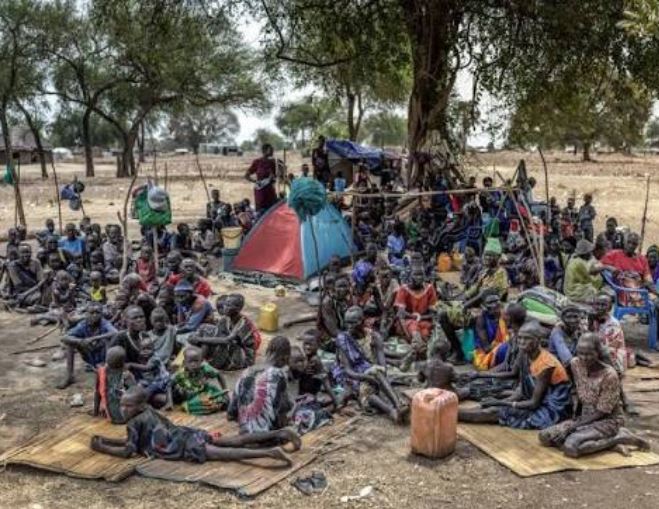
The African Union representatives expressed explicit alarm regarding the severe humanitarian toll of the ongoing conflict. United Nations agencies report that the fighting, which escalated into open urban warfare in April 2023, has resulted in tens of thousands of fatalities and displaced roughly 13 million civilians across the region. Vast sections of Sudan's civilian infrastructure, including hospitals, municipal water systems, utility grids, and agricultural supply chains, remain heavily damaged or completely destroyed by artillery exchanges and airstrikes.
During the bilateral discussions, Prime Minister Idris informed the delegation that the transitional government plans to initiate a domestic political dialogue shortly to address the governance vacuum. However, Sudanese civilian opposition figures and pro-democracy coalitions have publicly rejected recent military-backed dialogue proposals. These civilian groups argue that such initiatives lack mechanisms for a genuine ceasefire, civilian protection, or the restoration of a democratic transition. Opposition leaders assert that dialogue held exclusively in military-controlled territories will exclude key stakeholders necessary for a lasting, legitimate political settlement.
The African Union’s renewed engagement occurs as the Sudanese Armed Forces consolidate control over central Sudan and secure portions of the capital region, while the Rapid Support Forces maintain deep entrenchment across the western Darfur region and adjacent territories. This geographic divide has led to the establishment of competing political alliances, notably the Rapid Support Forces-backed Sudan Founding Alliance, prompting the African Union to explicitly reject any partition schemes that fracture the state.
Reopening Diplomatic Channels in Khartoum
The weekend diplomatic visit coincides with broader administrative plans by the African Union to officially reopen its liaison office in Khartoum. The continental bloc previously evacuated its personnel when heavy urban combat consumed the capital in early 2023. Restoring a physical diplomatic presence would render the African Union the sole entity within a five-member international mediation group—which includes the United Nations, European Union, Arab League, and the Intergovernmental Authority on Development (IGAD)—to operate directly from inside the capital city.
Regional security analysts and researchers from the Institute for Security Studies suggest that operating a permanent liaison office provides the continental body with stronger leverage to monitor ceasefire compliance, coordinate humanitarian access, and maintain direct, unmediated communication lines with Sudanese political and military actors. The delegation commended the transitional government's recent logistical efforts to restore basic administrative services and state functions from Khartoum, describing the functional return of state institutions as a required step for domestic stability.
Despite the diplomatic progress, the African Union Peace and Security Council faces the complex challenge of mediating the current conflict without inadvertently legitimizing the military seizure of power that originally triggered Sudan’s suspension from the bloc. The council’s core mandate requires member states to adhere strictly to democratic, civilian-led constitutional transitions.
Strategic Mediation Next Steps
Diplomatic sources indicate the African Union intends to expand its engagement with civilian political coalitions, regional leaders, and neighboring governments over the coming weeks to build consensus for a binding ceasefire agreement. The bloc continues to coordinate with the Intergovernmental Authority on Development to align regional mediation tracks and prevent contradictory peace initiatives from fragmenting the negotiation process.
Why did the African Union send a delegation to Sudan in August 2026?
The African Union dispatched a delegation to Sudan to hold direct talks with transitional authorities, press for a comprehensive ceasefire, and formally reject foreign military interference. The August 2026 visit marked the bloc's first diplomatic mission to Khartoum since suspending Sudan's membership following the October 2021 military coup.
Algerian diplomat Mohamed Khaled will conclude his term as the rotating chairperson of the African Union Peace and Security Council on August 31, 2026, ahead of the council's next scheduled leadership rotation in September.